For my first upload to this blog, I would like to talk about the building blocks of universe: fundamental particles. Fundamental particles are the smallest known particle and cannot be broken down into anything smaller. Scientists once thought that the electron, the proton and the neutron were the fundamental particles but with the invention of the particle accelerator we found out that, out of the three, only electrons were the fundamental particles.
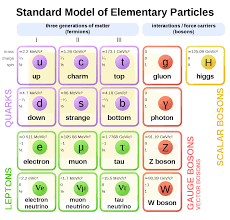
Fundamental particles contain 3 sections: leptons, quarks and gauge bosons. Leptons consist of the electron, muon and tau and their neutrino counterparts. Gauge bosons are associated with the four fundamental forces, with only the boson for gravity remaining undiscovered. However, the most well-known fundamental particles, the ones that make up almost all of the matter in the observable universe, are quarks.
Quarks are the building block of matter. In the standard model, there are 6 “flavours” of quarks called: the up quark, down quark, charm quark, strange quark, top quark and bottom quark. The up, charm and top quarks have a contain a +2/3 charge while down, strange and bottom quarks have a -1/3 charge. Quarks make up protons and neutrons, with the former having 2 up quarks and 1 down quark and the latter having 1 up quark and 2 down. Only up, down and strange quarks have been found within normal matter but the existence of other quark flavours has been proven through the particle accelerator. Scientists expect the other quarks to be found in stars.
Most matter can be separated into 2 sections: leptons, another fundamental particle that I will talk about in another article, and hadrons, matter made up of quarks. Hadrons can be further split into 2 sections: baryons, matter made up of three quarks, and mesons, matter made up of 2 quarks (one quark and another anti-quark). Antiparticles are the exact same particle and have the same mass but the opposite charge, lepton number, baryon number and strangeness.
Baryons have a baryon number of 1 meaning that all quarks have a baryon number of +1/3. Mesons, on the other hand, have a baryon number of zero as they are not baryons. To form this, they have a quark and its antiquark each cancelling its opposite particles baryon number. For example, let’s say we have an up quark and a down anti-quark and they form to become a meson. An up quark has a charge of +2/3 and a baryon number of +1/3. A down anti-quark, however, has a charge of +1/3 and a baryon number of -1/3 due to the properties of anti-particles saying that they have the opposite baryon number and charge. This means that the meson will have a charge of +1 but a baryon number of 0.
 Andromeda Science