As the first article on this website, it would be fitting that we journey back to the beginning of the universe.
‘What was there before the Big Bang?’ That’s a question that both kids and adults love to pose to anyone who seems sympathetic. After all, if the universe has only been around for roughly 14 billion years, isn’t it legitimate to ask what was in existence before the mother-of-all-events cranked up the cosmos? – Seth Shostak
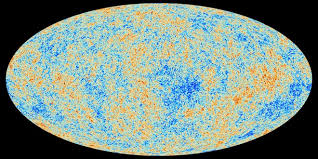
The above picture shows the background radiation levels of the observable universe. This radiation is remnants of the ancient event that created our universe. Thirteen billion years ago the Universe began in the event called the Big Bang. We don’t know why. We also don’t know why it took the initial form that it did. This is one of the unsolved mysteries that makes fundamental physics so exciting. The first milestone we can speak of in anything resembling scientific language is known as the Planck Era, a period that occurred 0.000000000000000000000000000000000000000001 seconds after the Big Bang. This number can be arrived at simply because it is related to the strength of the gravitational force. It is so incredibly tiny because gravity is so weak. At that time, the four fundamental forces – gravity, the strong and weak nuclear force, and electromagnetism – were one. There was no matter, only energy and the super force.
As the Universe rapidly expanded and cooled it underwent a series of symmetry-breaking event. The first saw gravity separate from the other fundamental forces so the prefect symmetry of the Planck Era was broken. After this, the strong nuclear force separated which resulted in the end of the Grand Unification Era. At this point, the Universe underwent a violent growth, expanding by a factor of 100 million million million million times in an unimaginably small time. This was when sub-atomic particles entered the universe.
After these events, one of the most important events in the creation of our universe occurred: the breaking of the electroweak symmetry. During this time, the sub-atomic building blocks of all we can see gained mass via the Higgs Boson, recently discovered at the Large Hadron Collider.
There is now one final step needed to arrive at the protons and neutrons – the building blocks of the elements. This began around a millionth of a second after the Big Bang, when the quarks had cooled enough to be glued together to form the protons and neutrons. After three minutes the universe consisted of two elements; the majority hydrogen and a small amount of helium. At this point the main process of creation was complete, with the universe consisting of 75% hydrogen and about 25% helium, and with the four fundamental forces having been separated.
Check out our other posts:
 Andromeda Science